Free Basics vs. Free Internet: Your Guide to the Raging Net Neutrality Debate
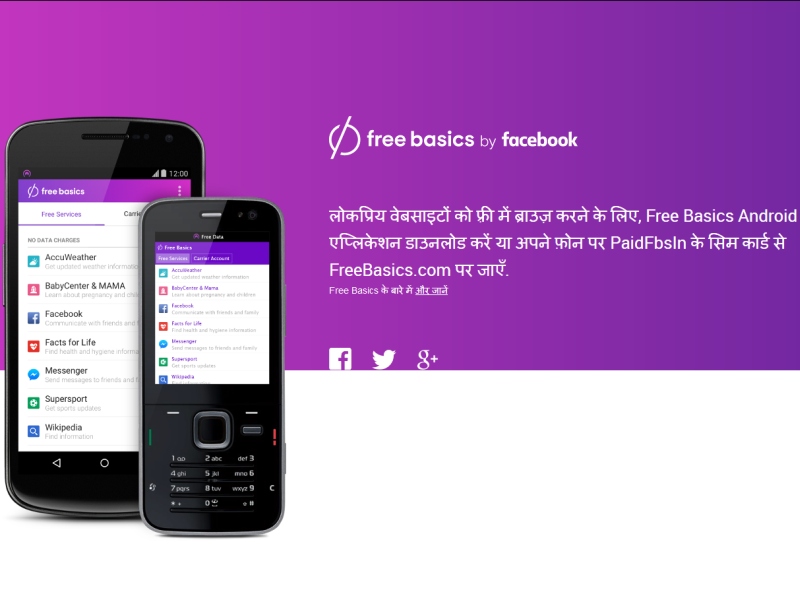
Free Basics, Facebook's non-profit initiative that aims to bring Internet connectivity to the underprivileged in developing regions, has run into trouble in India. Under Free Basics, Facebook is offering a range of services for free to thousands of users, but advocates and enthusiasts in the country are strongly encouraging users to discard Facebook's initiative. Why? 'Network neutrality' or 'net neutrality' is the reason - a concept that says a public network should treat all content, sites, and platforms equally.
It is around these questions that the net neutrality debate is raging across India and the world. In this article, we guide you through what net neutrality is, as well as the raging debate in India, while also pinpointing the developments that have taken place in this space.
But what is net neutrality?
The idea behind net neutrality is simple - treat all sites equally to give everyone a fair chance at growth, and reject the idea of monopolies. The term net neutrality was first coined by lawyer and scholar Tim Wu in 2003 in an academic paper also titled 'Network Neutrality, Broadband Discrimination,' which said that Internet service providers must treat all traffic on their networks equally.
The idea behind net neutrality is simple - treat all sites equally to give everyone a fair chance at growth, and reject the idea of monopolies. The term net neutrality was first coined by lawyer and scholar Tim Wu in 2003 in an academic paper also titled 'Network Neutrality, Broadband Discrimination,' which said that Internet service providers must treat all traffic on their networks equally.
In an updated definition on his site, Wu elaborates: "Network neutrality is best defined as a network design principle. The idea is that a maximally useful public information network aspires to treat all content, sites, and platforms equally. This allows the network to carry every form of information and support every kind of application. The principle suggests that information networks are often more valuable when they are less specialised - when they are a platform for multiple uses, present and future. (For people who know more about network design, what is just described is similar to the "end-to-end" design principle)."
Essentially, a telecom provider such as Airtel must not block or throttle access to any service on its network, even if Airtel directly or indirectly (via one of its partners) competes with the service. Alongside, offering a limited set of services for free (with no data charges) is also being considered against the concept of net neutrality, by edging out non-partnered services.
The first debate that rose around net neutrality earlier this decade revolved around data throttling, a practice that saw Internet service providers partnering with certain apps and websites to offer faster access to their users, with slow or blocked access to rival apps and websites. This concept of fast and slow lanes has since been outlawed in many countries, and almost everyone agrees it's against the concept of a free and fair Internet.
More recently, the debate on net neutrality shifted from a no-throttling and no-blocking clause to zero-rating platforms, where operators do not count the traffic generated by their own or partners' services against the end-users' monthly data caps. When telecom operators provide access to certain services for free, other players are put at an enormous disadvantage. In essence, they're turning the internet Into something like a cable TV subscription service with packages a user can subscribe.
Proponents of net neutrality find zero-rating platforms in violation of the principles regardless of whether a platform is paid for by partners, or is free - like Free Basics is claimed to be. The idea behind net neutrality is that the Internet should remain a level playing field for all.
So, what is Facebook's Free Basics?
First of all, it wasn't called Free Basics until September 2015. Formerly, it was known as Internet.org. The initiative is meant to provide free access to the Internet to the underprivileged in developing nations. Facebook has launched the initiative in 15 nations thus far, including India, where it debuted Internet.org in February this year in partnership with RCom, the fourth largest carrier in the country.
First of all, it wasn't called Free Basics until September 2015. Formerly, it was known as Internet.org. The initiative is meant to provide free access to the Internet to the underprivileged in developing nations. Facebook has launched the initiative in 15 nations thus far, including India, where it debuted Internet.org in February this year in partnership with RCom, the fourth largest carrier in the country.

